Wood-Burning Stoves: How to Choose the Right One in 2026

When looking for a wood-burning stove, many buyers get overwhelmed by the details and end up making the wrong choice. Knowing how to select the right stove is the key to enjoying a beautiful fire and spending a warm, cozy winter.
To make things easier for you, we have prepared a list of factors to consider during your search, helping you choose the ideal model.
Wood-burning stove buying guide:

1. Choosing the right-sized wood stove
Measure the space:
Calculate the area (in square feet or square meters) you wish to heat. As a general rule, allow for approximately 20 to 25 BTUs (British Thermal Units) per square foot, or refer to the power output in kilowatts (kW) (for example, a 5 kW stove is generally suitable for a standard living room).
Avoid oversizing:
Do not buy the largest stove available. A stove that is too powerful will make the room uncomfortably hot and force you to maintain smaller, less efficient fires, thereby promoting creosote buildup.
2. Choose between a freestanding stove and a fireplace insert
Freestanding stoves are typically installed in spaces that lack a pre-existing masonry fireplace; they are placed, for instance, on a brick or tile floor or on a heat-resistant hearth pad. These stoves come in various configurations: low-profile models on legs or elevated versions set on a base or pedestal. While some freestanding stoves can be installed directly inside a masonry fireplace opening, inserts are the ideal solution for seamlessly integrating a wood-burning heating system into an existing fireplace.

3. "Pro Tips" Efficiency, efficiency, efficiency
"Greater efficiency translates into savings on wood, less labor involved in cutting and hauling it, and a more environmentally friendly product. Older wood stoves tend to be inefficient and wasteful of fuel; this is why many manufacturers do not publish efficiency ratings for their units. To get the best value for your money, look for wood stoves with an EPA-certified efficiency rating of at least 70%. An efficient stove means less time spent cutting and stacking wood, as well as fewer trips to the woodpile during winter storms."
4. Air quality and EPA regulations– Canada / Quebec:
Canadian authorities often recognize EPA certifications or the equivalent CSA B415.1 standard. Municipalities such as Montreal impose a local threshold of 2.5 g/h for wood-burning appliances—rather than the stricter US limit of 2.0 g/h—though many modern EPA-certified stoves sold in the region easily meet or even exceed these standards.
5. Choosing the material: a strategic decision.
Key Takeaways:
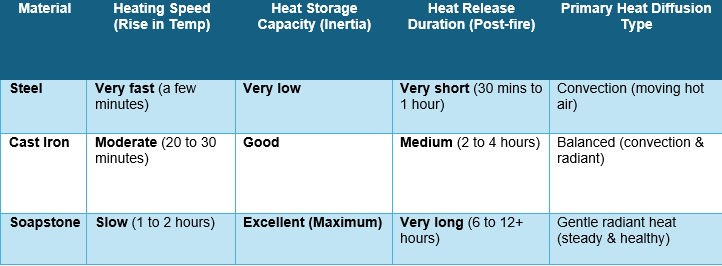
Steel heats up instantly, making it perfect for quick warmth, but it cools down just as fast once the fire goes out.
Cast Iron offers a great traditional balance, retaining and radiating comfortable heat for a few hours after extinction.
Soapstone acts as a thermal battery. It absorbs intense heat and releases it slowly and evenly, keeping your home warm long into the night.
Here is the direct comparison table showing heat retention for wood stoves among steel, cast iron, and soapstone (pierre stéatite) :

6. Catalytic vs. non-catalytic models
When they first appeared in the 1980s, catalytic stoves—wood stoves that use a catalyst to reduce emissions—gained a poor reputation. These early, poorly designed models were difficult to light and featured catalysts that became clogged and deteriorated after just a few seasons. Modern catalytic stoves no longer suffer from these flaws. Most catalytic wood stoves sold today are significantly cleaner and more efficient than their non-catalytic counterparts, and their catalysts can last ten years or more.
7. How to determine the right log size
The first step is to measure the internal dimensions of your wood stove's firebox. Specifically, measure the depth from the front of the firebox to the back, as well as the width of the opening.
General rule:
Most standard wood stoves are designed to accommodate logs between 12 and 16 inches long.
Safety margin:
Aim for logs that are at least 2 to 3 inches shorter than the depth of your firebox. This ensures essential airflow, prevents logs from touching the back of the firebox, and makes it easier to load and adjust the fire without forcing the wood.
Too long:
Logs that are too long won't fit; if forced in, they can block airflow, cause incomplete combustion, and potentially damage the appliance or the chimney.
Too short:
While less problematic than being too long, excessively short pieces may burn too quickly or require more frequent reloading to maintain a steady fire.
"Pro Tips" – The secret to success:
"Dry wood has a moisture content of less than 20%, allowing for more efficient and cleaner combustion. This means you get more heat from the same amount of wood, thereby reducing your consumption."
What else do you need? (The essentials)
To install a wood-burning stove, you will generally need a flue system, a connecting pipe, a floor plate, and basic safety accessories. The specific items required will depend on the setup: installation in an existing fireplace or the use of a twin-wall flue system.
Flue liner, twin-wall system, or insulated chimney:
To safely vent exhaust gases.
Closure plate (for open fireplace conversions):
A metal plate designed to seal the base of the fireplace opening, preventing heat from escaping upwards and soot from falling back down.
Connecting pipe:
A black pipe connecting the top of the stove to the flue system.
Floor plate:
A non-combustible base (usually made of glass, steel, slate, or granite). If your stove is certified not to heat the floor beneath it to more than 100°C, you can opt for a sleek 12mm glass plate.
Accessories:
Heat-resistant glove, carbon monoxide detector (legally required), and log basket.
FAQ
- What wood stove output should I choose?
You should choose a wood stove based on the area to be heated.
- What is a catalytic wood stove, and is it more efficient?
Most catalytic wood stoves sold today are significantly cleaner and more efficient than their non-catalytic counterparts.
- Are wood stoves still permitted in Montreal in 2026?
Yes, provided the unit has an emission rate of less than 2.5 g/h.
- How much do a wood stove and chimney cost?
The total budget varies depending on the quality and efficiency of the wood stove (ranging from $1,500 to over $8,000) and the length of the chimney flue (ranging from $1,500 to over $5,000).
- What is the difference between a wood stove and a wood-burning fireplace insert?
A stove is a freestanding unit placed in the room with an exposed pipe, whereas an insert is a metal unit installed inside an existing masonry or prefabricated fireplace.
- How often should a wood stove chimney be swept?
At least once a year; if you use your stove daily during the winter, a second sweeping mid-season is recommended.

Daniel Rochon for Artefo Inc.
A specialist in chimneys, stoves, and fireplaces, Daniel turns technical details into simple, accessible advice. Through expert content, he clears up buyers' uncertainties and highlights the essentials, helping them choose and use their equipment with confidence.


Comments